Who You Think You Are vs. What the Data Says: How to Read Your Style Stats
Who You Think You Are vs. What the Data Says: How to Read Your Style Stats
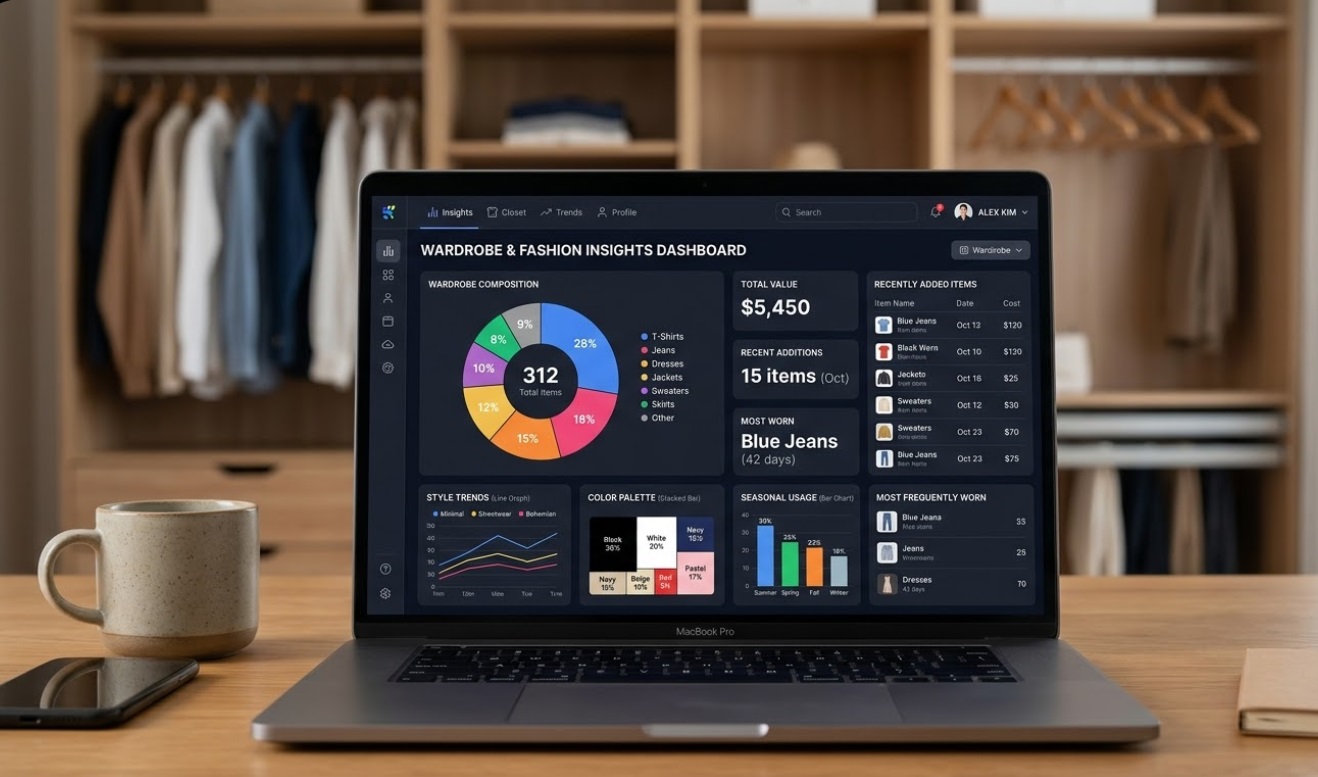
"I'm a total black lover," you say—only to find out that black actually makes up just 28% of your wardrobe. The moment you open your Style stats for the first time, the reaction is almost always the same: "Wait, is this really me?"
We’re all a little delusional about our Closets
Take a second to think. What’s the color you wear most often? What’s your most-worn Item?
Most people answer with total confidence: "I mostly wear black." "I like to experiment with different colors." "I wear everything in my Closet pretty evenly."
But when we look at the data, the story changes. One user who claimed to wear "a variety of colors" found that their top three colors accounted for 72% of all their Outfits. Another who said they "wear everything" actually had an average of 34% of their clothes sitting untouched.
This isn't about being dishonest; it's just how human memory works. Our brains tend to store recent, vivid memories as if they represent the whole picture. If you wore a red knit once last week, your brain logs it as: "I wear red all the time."
Data corrects this illusion. And that moment of clarity is exactly where the journey to truly understanding your Closet begins.
What your color map is actually saying
The first thing to look at in your Style stats is the color distribution.
A well-balanced Closet usually follows a structure like this: 60–70% neutrals (black, white, navy, gray), 20–30% accent colors, and 5–10% seasonal trend colors.
Think of this as a baseline rather than a strict rulebook. The goal is to spot surprises, like "Wait, did I really have this much beige?" If your neutral ratio is too high, your styling can easily feel repetitive. If your accent ratio is too high, you might find it difficult to put an Outfit together.
However, there is one metric even sharper than color—a number that reveals the honest value of your clothes.
Cost Per Wear (CPW): The real value of your clothes
The most powerful number in your Style stats is CPW (Cost Per Wear). It’s simply the purchase price divided by the number of times you’ve worn the Item.
Looking at it in a table makes it click instantly:
| Item | Price | Wears | CPW |
|---|---|---|---|
| White T-shirt | $30 | 48 | $0.62 |
| Blue Jeans | $115 | 156 | $0.73 |
| Designer Dress | $670 | 2 | $335.00 |
| Sale Cardigan | $35 | 1 | $35.00 |
See the difference? That $30 white tee is hundreds of times more efficient than the $670 dress. Even that cardigan you grabbed on sale becomes an expensive mistake if you only wear it once.
CPW isn’t a sign to stop buying expensive things. It’s a reminder that "the clothes you don't wear are the most expensive ones." If you wear that $670 dress 60 times, the CPW drops to about $11—completely reasonable. The problem is when the count stops at two.
Once you know these numbers, the next question follows naturally: "So, what do I do with this data?"
Discover, Interpret, Act: The 3-step plan

Looking at stats won't change anything on its own. You need to turn those numbers into action through three steps.
First: Discover. Open your dashboard once a month and check three things: Your Top 5 most-worn Items of the month, the Items you haven't touched once, and the 3 Items with the highest CPW.
Second: Interpret. Ask "Why?" for each pattern. Why haven't you worn that sale cardigan? Is it the fit? Does the color clash with your other clothes? Is it just not your style anymore? Identifying the reason prevents you from making the same mistake twice.
Third: Act. Turn these insights into three or fewer specific actions. "This spring, I'll only buy navy tops," "I will try 3 new Outfit combinations for Items with a CPW over $30," or "List the unworn cardigan for resale." Keep it simple—the fewer the goals, the more likely you are to stick to them.
Invest just 15 minutes once a month into these three steps. As your data grows over time, you’ll start to see your own personal shopping rules take shape.
Building your own personal shopping rules
After a few months of tracking, rules will start to emerge naturally:
"If I already have three Items in the same color and Category, I won't buy another." "A new Item must match at least two of my Top 5 most-worn Items before I buy it." "Set a maximum price based on my target CPW—if my goal is under $1 per wear for daily essentials, and I plan to wear these pants twice a week for one season (approx. 30 times), my budget is $30."
These are rules no one else can teach you. They come directly from your data. This is why Style stats matter—they don't give you general fashion advice; they tell your story.
Open your Style stats tonight. The gap between the "you" in your head and the "you" in the data is where your most exciting style discoveries begin.
❓ FAQ
Q: What’s a 'good' CPW?
A: There’s no set rule, but aiming for under $1–$2 for everyday wear and $5–$10 for formal wear is a great starting point for a sustainable Closet.
Q: How long does it take to get meaningful data?
A: You’ll need at least 1–2 months of logging your Outfits to see patterns. By 3 months, the data becomes very reliable.
Q: Can I check these stats in Acloset?
A: Yes! Once you register your clothes and log your daily Outfits, Acloset automatically calculates your color distribution, Category ratios, wear counts, and CPW in the Style stats section.
References & Sources:
- ThredUp, "Resale Report," 2025
- WRAP UK, "Valuing Our Clothes," 2023
- World Bank, "How Much Do Our Wardrobes Cost to the Environment?"
Published by the Acloset Magazine Team.
Start Organizing Your Closet
Dress better, buy less — with Acloset.