Same Face, Different Lighting: A Journey Through the Four Seasons — A Guide to Personal Color Analysis
Same Face, Different Lighting: A Journey Through the Four Seasons — A Guide to Personal Color Analysis
"Am I a Cool tone or a Warm tone?" It seems like everyone’s asking this question lately. But if your AI analysis says you're a Cool Winter under fluorescent lights, a Cool Summer in natural light, and a Warm Autumn under incandescent bulbs—who are you supposed to believe?

Personal Color: The New MBTI
Interest in personal color analysis has absolutely exploded, especially in Korea. The most popular studios in Seoul are fully booked for both Korean and English sessions (Harper's Bazaar Singapore, 2024). With professional consultations costing anywhere from $50 to $110, it has become the ultimate tool for self-discovery, right alongside MBTI.
But why is it so popular? Beyond simple curiosity, there are some very practical perks.
Knowing your palette means fewer shopping fails. It drastically cuts down the time you spend in a store wondering, "Does this color actually look good on me?" Once you know your range, your options become more focused, and your chances of making a mistake drop. Whether you're building a capsule closet or putting together an Outfit, the difference between knowing your palette and winging it is huge.
The real question is how to find it. Should you go for a quick AI fix or see a professional? The short answer: both. But the order is what matters.
The Achilles' Heel of AI Analysis
Let's get real about AI diagnosis for a second.
AI personal color apps are fast and affordable. Many are free, and even the paid ones rarely exceed $18. You just snap a photo, and you get your results in 1 to 5 minutes.
The problem? Lighting. If you take photos of the same face under different lights, the results can be completely different.
Natural light (by a north-facing window) might give you Cool Summer; fluorescent light might say Cool Winter; incandescent bulbs might suggest Warm Autumn; and a ring light might flag you as Warm Spring. It’s the same person, yet they’ve traveled through all four seasons in one day.
This isn't because the AI is "bad." It's a limitation of how cameras interpret light. When the color temperature of the light reflecting off your skin changes, the actual color data the AI reads changes with it. This is exactly why controlled lighting is mandatory for professional consultations.
Does that mean AI is useless? Not at all. It just has a specific role to play.
Compass vs. GPS: A 2-Step Approach
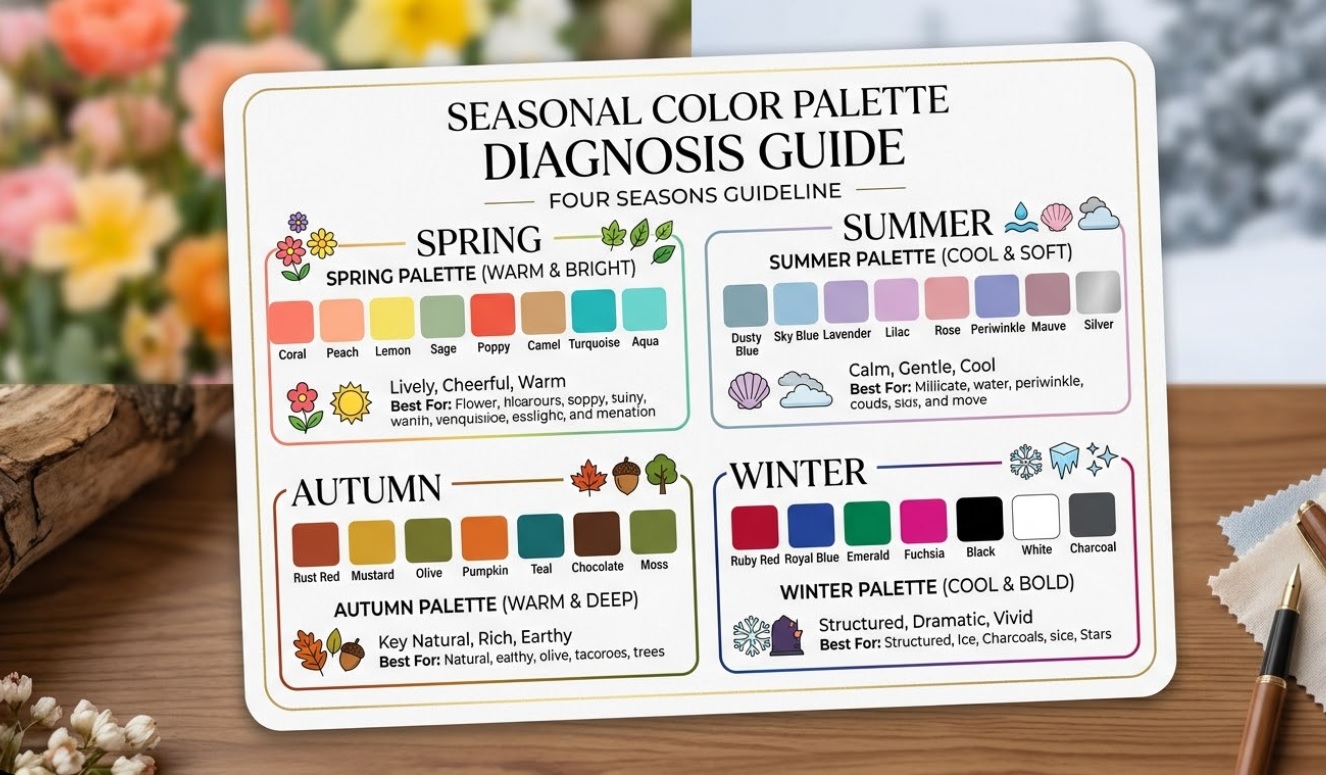
Don't view AI and professionals as competitors. They serve different purposes.
Step 1: Explore with AI. This is the stage where you form a hypothesis, like "I think I might be a Cool tone." Since it’s free or cheap, there's no pressure. If you repeat the process 2 or 3 times under the same conditions (natural light, no makeup, white top), you’ll start to see a consistent direction. Think of AI as your compass—it might not give you the exact coordinates, but it tells you which way to walk.
Step 2: Confirm with a Professional. To find your exact subtype (like whether you're a Cool Summer or a Cool Winter), you need "draping" in a controlled environment. A professional will place various colored fabrics near your face to observe subtle changes in your skin tone, a process that usually takes 1.5 to 2.5 hours. This is your GPS—it pins your exact location.
AI costs 0–$18, while professionals cost $70–$350. That’s a big gap. You might not even need both. If AI consistently gives you the same result, your general direction is likely correct. You only need the pro if you want to dive deep into those specific subtypes.
Regardless of how you get your results, don't just stop there. The real value comes afterward.
Connecting Your Results to Your Closet
Most people stop at "Oh, I'm a Cool Summer!" and leave it at that. But the real magic happens when you connect those results to your closet.
Go through the clothes in your closet one by one and tag them. Is this item a Best color, a Second color, a Neutral, or a color to Avoid?
This process leads to some eye-opening discoveries. You might realize, "Wow, a huge chunk of my clothes are in my 'Avoid' category," or "Only 15% of my clothes are in my 'Best' palette." This gives you objective data to work with.
One important tip: Don't throw away your 'Avoid' colors. Just be strategic. Save your Best colors for items close to your face—like tops, scarves, and mufflers. For things further away, like pants, bags, or shoes, your 'Avoid' colors are perfectly fine. It’s the colors closest to your face that define your overall look.
Use this data for your next shopping trip. Pick your basics in Neutral colors and your statement pieces in your Best colors. This one rule will instantly boost your shopping success rate.
And finally, remember one thing—no diagnosis is more important than your own intuition. Even if the data says a certain shade is an "Avoid" color, if you feel happy and confident wearing it? That’s your real Best color.
❓ FAQ
Q: How can I get a more accurate AI personal color diagnosis?
A: Take your photo in natural light (near a north-facing window), without makeup, and while wearing a white top. Repeating this 2–3 times under the same conditions will help you get a consistent result.
Q: Professional consultations are pricey. Is AI enough?
A: AI is great for figuring out your general direction (Warm vs. Cool). If you just want to stop making shopping mistakes, the general direction is often enough. If you want to know your exact subtype, go for the pro.
Q: Can I use personal color within Acloset?
A: Yes! By adding color tags to the items in your closet, you can analyze your Best color ratio. Plus, you can receive AI Styling recommendations that factor in your personal color results.
References & Sources:
- McKinsey (2024), Consumer Sentiment Survey
- Harper's Bazaar Singapore (2024), "Seoul's Color Analysis Craze"
- Jackson, C. (1980), Color Me Beautiful
Published by the Acloset Magazine Team.
Start Organizing Your Closet
Dress better, buy less — with Acloset.